5 Tips for Beginners
5 Yoga Tips for Beginners: Start Without Pressure or Perfection
If you've never tried yoga before, starting can feel surprisingly intimidating.
You might see people holding complicated poses, balancing on one leg, folding themselves into positions that seem completely impossible, and wonder:
“Am I even flexible enough to do this?”
Maybe you've tried a class before and felt like everyone else knew what they were doing.
Maybe you're worried about looking awkward.
Maybe you don't know the names of the poses.
Or maybe the word “practice” itself makes you feel like there's something you're supposed to be good at.
You can let all of that go.
You don't need to be flexible to begin yoga.
You don't need to know how to do every pose.
You don't need expensive equipment.
And you certainly don't need to look like someone in a yoga photograph.
Yoga can be much simpler than that.
At its most useful, it can be a way of reconnecting with your body, noticing your breath, and paying attention to what you're experiencing instead of constantly trying to control it.
For beginners, that's often a much better place to start than worrying about perfect alignment or advanced poses.
Here are five simple things to know before you begin.
1. You Don't Need to Be Flexible to Start
This is probably the biggest misconception beginners have.
People often think:
“I'm not flexible enough for yoga.”
But flexibility isn't an entry requirement.
It's simply one of the things that may change as you practice.
You don't need to touch your toes.
You don't need to put your leg behind your head.
You don't need to sit comfortably in a deep stretch.
You don't even need to be able to get into every pose.
Your body has its own structure, history, movement patterns, and limitations.
Two people can do the same pose and look completely different.
One person may naturally have a large range of motion.
Another may feel the stretch much sooner.
Neither person is automatically doing yoga “better.”
Work With the Body You Have Today
Instead of asking:
“How far can I get into this pose?”
try asking:
“What does this movement feel like in my body?”
That question changes the experience.
You start noticing tension.
You notice where you're comfortable.
You notice where you need support.
You notice when you're pushing too hard.
You begin listening instead of forcing.
And that's a much more useful skill than simply trying to make a pose look a certain way.
Use Support Without Feeling Guilty
Beginners often feel like using a chair, wall, cushion, folded towel, or other support means they're doing something incorrectly.
It doesn't.
Support can make movement more accessible and comfortable.
If your balance isn't steady, use a wall.
If sitting on the floor is uncomfortable, sit on a chair or cushion.
If reaching the floor requires you to strain, bring the floor closer with a support.
Modification isn't failure.
It's information.
It tells you how to make the practice work for your body.
2. There Is No Perfect Version of a Pose
A common beginner mistake is trying to copy exactly what someone else is doing.
You see their arms positioned a certain way.
Their back looks straight.
Their legs are at a particular angle.
So you try to recreate the picture.
But your body isn't a picture.
It's moving.
And your proportions, mobility, balance, strength, and previous experience are different from someone else's.
The same pose can therefore look different from person to person.
That's normal.
Focus on the Feeling, Not the Photograph
Instead of trying to make your body look like the demonstration, pay attention to a few basic things.
Can you breathe comfortably?
Do you feel stable?
Are you experiencing a manageable stretch rather than sharp pain?
Can you remain aware of what's happening?
Are you forcing yourself into a position simply because you think you should?
These questions are more useful than asking whether your pose looks perfect.
If a movement causes sharp, sudden, or concerning pain, stop and adjust rather than pushing through it. Yoga shouldn't require you to ignore your body's warning signals.
And if you have an injury, medical condition, or significant physical limitation, getting appropriate professional guidance before starting a new movement practice can help you modify it safely.
3. Your Breath Matters More Than How the Pose Looks
If you remember only one thing from this article, remember this:
Keep breathing.
Beginners sometimes become so focused on getting a pose right that they unconsciously hold their breath.
Their shoulders tense.
Their jaw tightens.
Their entire body starts working against the movement.
That's usually a sign to slow down.
Your breath gives you something to return to.
Instead of thinking:
“Am I doing this correctly?”
you can ask:
“Can I breathe here?”
If the answer is yes, stay curious.
If your breathing becomes strained, that's useful information.
Maybe you need to reduce the range of motion.
Maybe you need to come out of the pose.
Maybe you need to rest.
Maybe you're simply trying too hard.
Use the Breath as an Anchor
You don't need complicated breathing exercises to begin.
Simply notice your inhale.
Notice your exhale.
Feel your rib cage move.
Notice the sensation of breathing through your nose or mouth.
When your attention wanders, return to the breath.
This is one of the reasons yoga can become more than physical movement.
You're not only moving your body.
You're practicing paying attention while you're in the body.
That can be especially useful if you're someone who spends much of the day thinking, planning, working, worrying, scrolling, or reacting.
For a few moments, your attention comes back to something physical and immediate.
4. Modify Without Guilt
There is a tendency to think of modifications as something you use only when you're “not good enough” to do the full pose.
Try changing that idea.
A modification isn't a lesser version.
It's simply another version.
If a standing movement feels unstable, hold onto a wall.
If a seated pose is uncomfortable, use a cushion.
If a stretch feels too intense, reduce the range.
If getting onto the floor doesn't work for you, choose a standing variation.
If your energy is low, make the movement smaller and slower.
Your practice should meet you where you are.
Your Body Changes From Day to Day
This is something beginners don't always expect.
You may feel different every time you practice.
One day you might feel energetic.
Another day you might feel stiff.
You might sleep badly.
You might have spent hours sitting.
You might feel stressed.
You might have sore muscles from another activity.
You might simply wake up in a different mood.
So the “right” version of a pose can change from day to day.
That's not inconsistency.
That's being human.
A useful practice leaves room for that.
Try the “Less” Option First
If you're unsure whether you've gone too far, back off slightly.
Make the movement smaller.
Relax your shoulders.
Bend your knees.
Use support.
Take a breath.
Then reassess.
You can always move further if your body feels ready.
You don't need to prove anything by going as far as possible immediately.
5. Don't Try to Become Good at Yoga
This may be the most important tip of all.
You can turn almost anything into another performance.
Exercise becomes a competition.
Meditation becomes a productivity tool.
Food becomes a test of discipline.
And yoga can become another thing you're trying to be “good” at.
But that can completely change the purpose of the practice.
Instead of connecting with your body, you're judging it.
Instead of noticing your breath, you're comparing yourself.
Instead of asking what feels supportive, you're asking whether you're keeping up.
You don't need that.
Yoga Isn't a Test of Your Body
You don't have to look graceful.
You don't have to memorize Sanskrit names.
You don't have to complete advanced poses.
You don't have to practice for an hour.
You don't have to post your progress.
You don't have to compare your flexibility with anyone else's.
You can simply move.
You can breathe.
You can notice.
You can stop when you need to.
That's enough.
What Should a Beginner Expect?
If you're completely new, you might be surprised by how ordinary the first few sessions feel.
You may feel stiff.
You may wobble.
You may forget what comes next.
You may lose your balance.
You may notice muscles you haven't paid attention to in a long time.
You may feel awkward.
You may even laugh at yourself.
None of that means you're doing it wrong.
Learning a new physical practice takes time.
Your attention also needs time to adjust.
At first, you might spend the entire session thinking:
“Is this right?”
Eventually, you may spend more time actually noticing your body.
That's progress.
Not necessarily being able to perform a more difficult pose.
Just becoming more comfortable paying attention.
Start With Short Sessions
You don't need to commit to an hour-long yoga practice.
Start with five or ten minutes.
That's enough to learn what your body feels like when you slow down.
You can gradually increase the time if you enjoy it.
A short practice might include:
A few comfortable breaths
Gentle neck and shoulder movements
Standing stretches
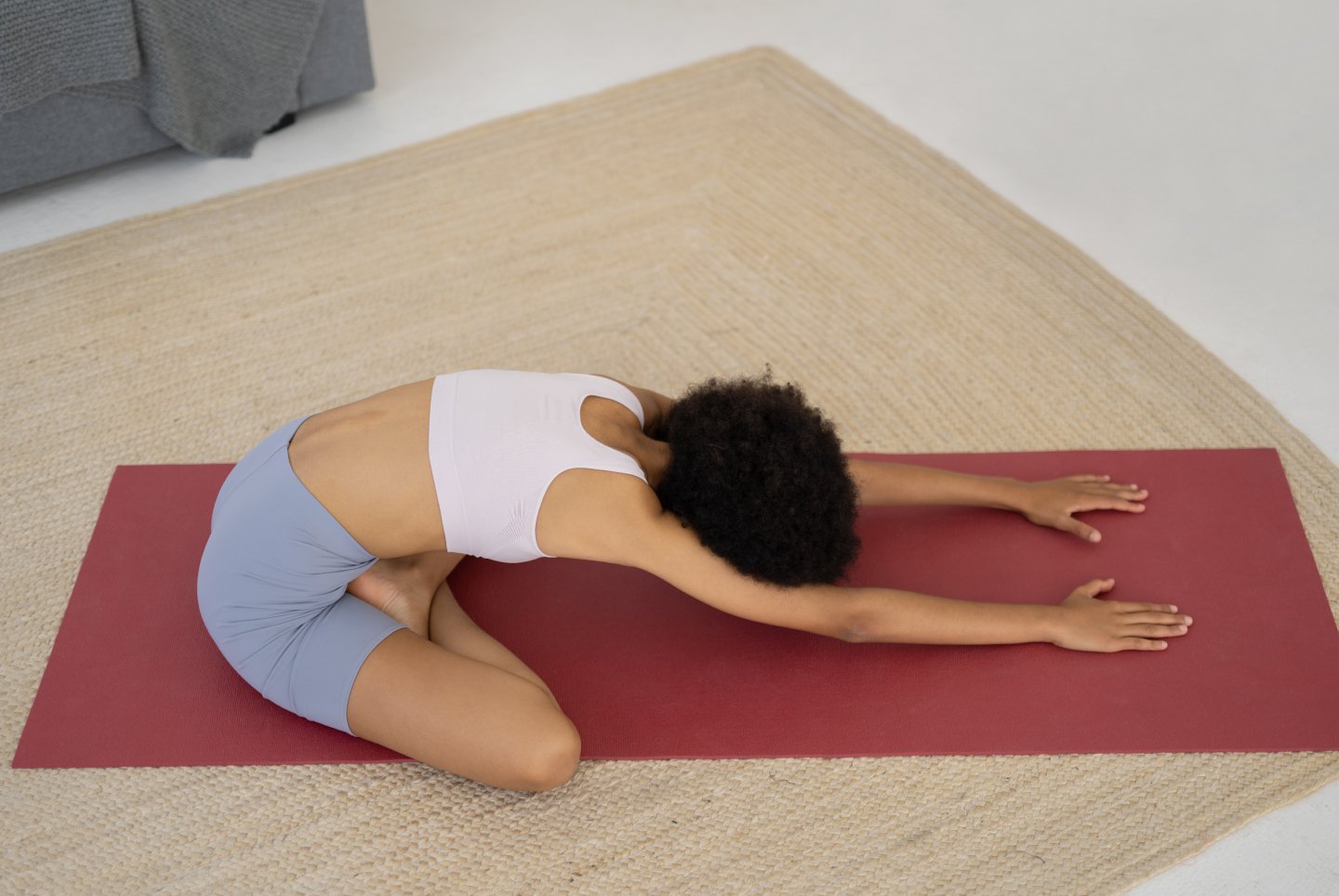
A simple forward fold modified to your ability
Gentle hip or leg movements
A few moments lying or sitting quietly
A final body check-in
There is no requirement to make the sequence complicated.
The simpler it is, the easier it may be to return to.
Yoga and Body Awareness
There's another reason beginner yoga can be useful.
Many of us spend a lot of time trying to control our bodies.
We try to change how they look.
We try to make them smaller.
We try to make them stronger.
We try to make them more productive.
We judge what they eat.
We judge how they move.
We judge how they look in clothes.
And sometimes we become so focused on changing the body that we stop paying attention to what it is actually experiencing.
A mindful movement practice can offer a different relationship.
Instead of asking:
“How can I change my body?”
you can spend a few minutes asking:
“Can I be with my body as it is today?”
That doesn't mean giving up on goals.
It doesn't mean you can't become stronger or more flexible.
It simply means your body doesn't have to become different before it deserves your attention.
This Can Also Change How You Approach Food
Body awareness doesn't stop when the movement ends.
The same awareness can carry into eating.
For example, you may start noticing the difference between:
“I want food because I'm physically hungry.”
and:
“I want food because I'm stressed and need a break.”
Or:
“I'm still hungry.”
versus:
“I'm eating because I'm distracted.”
There won't always be a simple answer.
And emotional eating isn't something you need to feel ashamed of.
Food can be comforting.
Food can be social.
Food can be enjoyable.
Food can be connected to memories and emotions.
The goal isn't to remove those connections.
It's to become more aware of them.
When you can notice what's happening in your body without immediately judging it, you may have more freedom in how you respond.
Don't Turn Yoga Into Another Food Rule
This is especially important.
Don't use yoga as a way to compensate for eating.
You don't need to do an extra practice because you ate dessert.
You don't need to “burn off” a meal.
You don't need to skip food because you didn't move enough.
Movement isn't punishment for eating.
And food isn't a reward for exercising.
Your body needs both nourishment and movement.
They can coexist without one being used to justify the other.
A healthier relationship with movement can include walking, stretching, yoga, strength training, rest, or simply moving through your day.
The important thing is that movement doesn't have to become another way of criticizing your body.
A Beginner's 10-Minute Practice
If you want to start immediately, keep it simple.
Minute 1: Arrive
Stand or sit comfortably.
Notice your feet or the surface supporting you.
Take a slow breath.
Minutes 2–3: Breathe
Notice your inhale and exhale.
Don't force anything.
Just follow the breath.
Minutes 4–5: Move Your Upper Body
Roll your shoulders.
Move your arms.
Gently turn your neck.
Relax your jaw.
Minutes 6–7: Move Your Legs
Walk slowly.
Stretch your calves.
Move your ankles.
Do whatever feels comfortable.
Minutes 8–9: Gentle Stretch
Choose one or two comfortable stretches.
Don't force the range.
Keep breathing.
Minute 10: Pause
Stop moving.
Notice your body.
Ask:
“How do I feel now?”
That's your practice.
No complicated sequence required.
Five Things to Remember Before Every Practice
If you're new to yoga, keep these five reminders nearby:
1. You don't need flexibility.
Your body can learn movement while being exactly where it is today.
2. There is no single perfect shape.
Modify the pose to suit your body.
3. Keep breathing.
Your breath is more important than making a pose look impressive.
4. Use support.
A wall, chair, cushion, or smaller range of motion isn't something to feel guilty about.
5. You don't have to be good at yoga.
You're here to reconnect with your body, not perform for it.
Come As You Are
Maybe today you're stiff.
Maybe you're tired.
Maybe you haven't exercised in months.
Maybe you've spent years feeling disconnected from your body.
Maybe you've spent years trying to control it.
Maybe you're uncomfortable with how your body looks.
You don't need to solve any of that before you begin.
Start where you are.
Not where you think you should be.
Not where someone else is.
Not where you hope to be six months from now.
Where you are today.
Take a breath.
Make the movement smaller if you need to.
Use a chair.
Use a wall.
Stop when you need to.
Rest.
Try again.
The practice isn't asking you to become someone different.
It's giving you a few minutes to notice the person already here.
The Real Practice Is Coming Back
Some days you will enjoy yoga.
Some days you won't.
Some days you'll feel flexible.
Some days you'll feel stiff.
Some days you'll have ten minutes.
Some days you'll have two.
That doesn't make one day a success and the other a failure.
The practice is simply returning.
Returning to your breath.
Returning to your body.
Returning to the present moment.
And returning without turning the experience into another judgment.
That's a skill worth building.
Because the more comfortable you become noticing your body without immediately trying to change it, the more space you may create for choices around movement, food, rest, and everyday life that aren't driven entirely by guilt or autopilot.
Start Today, Not When You're “Ready”
You don't need the right clothes.
You don't need the right body.
You don't need the right level of flexibility.
You don't need a perfect room.
You don't need to know what you're doing.
You can begin with one breath.
Then one movement.
Then another.
Let today be today.
Your body doesn't need to prove anything before you listen to it.
And yoga doesn't have to be about becoming good at yoga.
It can simply be a few quiet minutes where you stop trying to control your body long enough to actually feel it.
Show up as you are. Breathe as you are. Move as you are. Start from there.