Daily Calm
A Simple Daily Mindfulness Practice for Emotional Eating
You don't need a complicated routine to feel more settled.
You don't need a 60-minute meditation session, a perfect morning routine, or a completely silent house.
Sometimes, a few quiet minutes are enough to create a small gap between what you're feeling and what you automatically do next.
That's the purpose of this practice.
Come back to it every day—not because it's impressive, difficult, or something you can brag about, but because consistency matters more than intensity.
Your nervous system doesn't need another challenge to complete.
It needs repeated experiences of slowing down.
When you practice calming your body regularly, you're giving yourself another option besides reaching for food, caffeine, your phone, or some other form of stimulation whenever you feel uncomfortable.
The practice is short.
It's simple.
And most importantly, it still counts on the days when you don't particularly feel like doing it.
Why Consistency Matters More Than Intensity
A common mistake with mindfulness is making it too ambitious.
Someone decides they're going to meditate for 30 minutes every morning.
They do it for three days.
Then they miss one morning.
Then two.
Eventually the entire routine disappears.
The problem wasn't that they lacked discipline.
The routine was simply too demanding to become part of normal life.
A five-minute practice that you actually repeat is more useful than a 45-minute practice you constantly postpone.
That's especially true when your goal is to change an automatic habit such as emotional or mindless eating.
You're not trying to create one extraordinary moment of calm.
You're trying to make calm and awareness more familiar.
That happens through repetition.
What This Practice Is Actually For
This isn't a weight-loss exercise.
It isn't designed to make you suppress hunger.
It isn't supposed to eliminate every craving.
And it isn't a way to prove that you have enough self-control.
The purpose is much simpler:
Notice what's happening before you automatically react.
You might notice:
"I'm hungry."
"I'm stressed."
"I'm exhausted."
"I'm bored."
"I need a break."
"I'm craving something sweet because I've been working for three hours."
Sometimes you'll still choose to eat.
That's completely fine.
Mindfulness isn't successful only when you say no to food.
It's successful when you become more aware of why you're making the choice.
The Daily Practice: Just Five Minutes
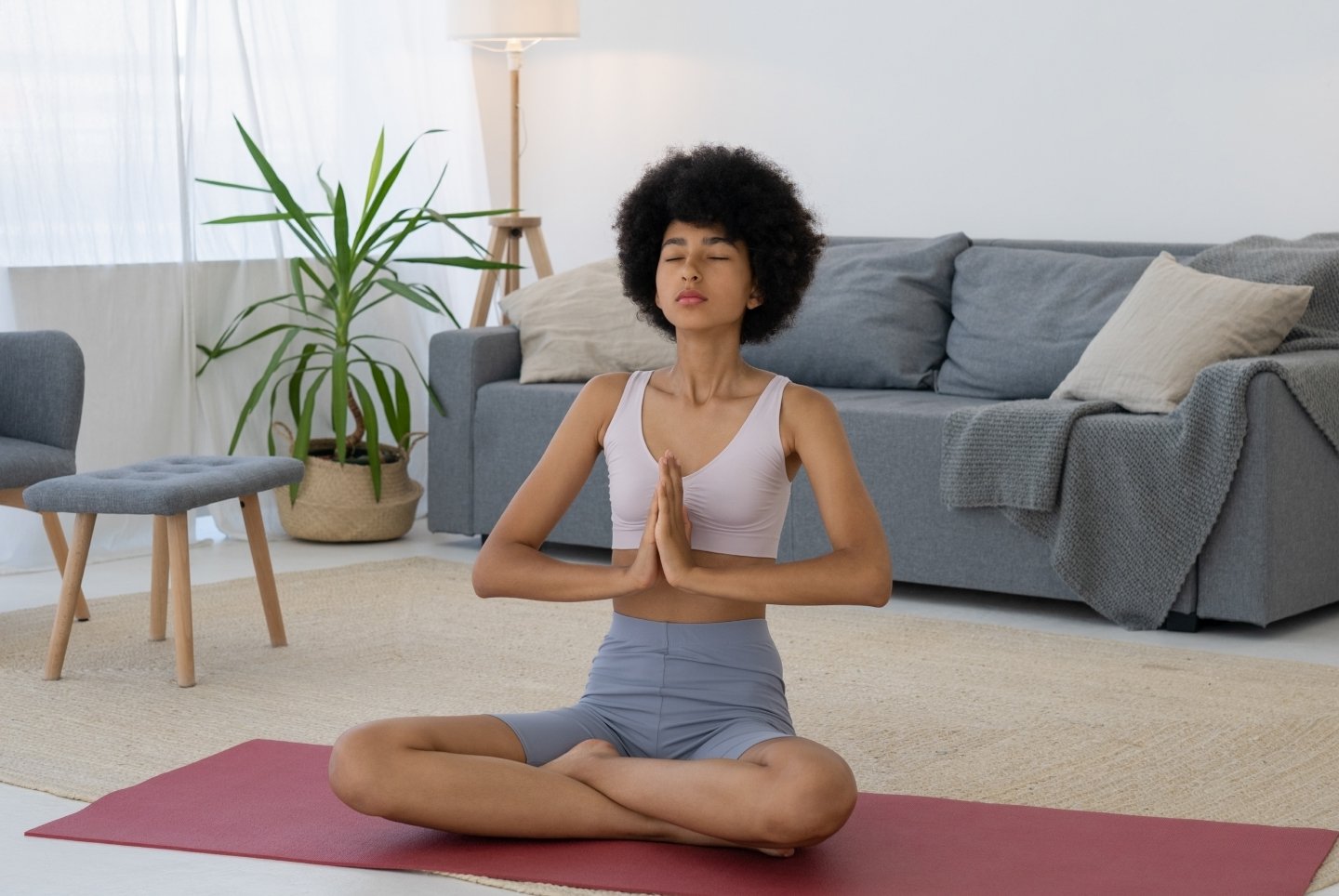
You can do this sitting on your bed, in a chair, on the floor, or anywhere you can be relatively undisturbed.
You don't need special clothes.
You don't need equipment.
You don't need to sit in a particular meditation position.
Get comfortable.
Then follow five simple steps.
Minute 1: Stop
For the first minute, don't try to fix anything.
Just stop.
Put your phone down.
Stop typing.
Stop scrolling.
Let your hands rest.
Notice that you've moved from doing something to doing nothing.
You may immediately notice how restless your mind feels.
That's normal.
You might think about work.
Food.
Messages.
Money.
Tomorrow.
Something that happened yesterday.
Don't chase any of those thoughts.
Just notice them.
Minute 2: Breathe
Bring your attention to your breathing.
Don't force deep breaths.
Don't try to breathe perfectly.
Just notice the inhale.
Then notice the exhale.
If it feels comfortable, allow the exhale to become slightly slower than the inhale.
Continue for several breaths.
Your mind will wander.
That's expected.
When you notice it has wandered, gently return your attention to the next breath.
You don't need to get annoyed with yourself.
The moment you notice you've become distracted is actually part of the practice.
Minute 3: Notice Your Body
Now bring your attention to your body.
Notice your shoulders.
Your jaw.
Your chest.
Your stomach.
Your hands.
Your legs.
Ask yourself:
"What am I feeling physically right now?"
Maybe your shoulders are tense.
Maybe your stomach feels empty.
Maybe you're comfortable.
Maybe you're restless.
Maybe you're tired.
Don't immediately interpret the sensation.
Just notice it.
This is particularly useful when you're dealing with emotional eating because physical sensations can sometimes get mixed together with emotional urges.
The practice gives you a chance to slow down enough to tell the difference.
Minute 4: Name What You Need
Ask yourself:
"What do I need right now?"
Keep the answer simple.
Maybe you need food.
Maybe you need water.
Maybe you need movement.
Maybe you need five minutes away from your screen.
Maybe you need to finish an important task.
Maybe you need rest.
Maybe you need to deal with something that's bothering you.
You don't have to solve your entire life during this minute.
You're simply checking in.
Minute 5: Choose
Now make one deliberate choice.
If you're hungry, eat.
If you're tired, start preparing for rest.
If you're stressed, take another minute to breathe.
If you've been sitting for hours, stand up and walk.
If you're bored, decide whether you actually want the snack or simply want stimulation.
The important part is that you choose after checking in, rather than reacting immediately.
Then continue with your day.
That's the entire practice.
Use It First Thing in the Morning
Morning is one of the easiest times to establish a consistent mindfulness habit because you haven't yet accumulated an entire day's worth of stress and distractions.
You don't need to wake up at 5 a.m.
You don't need to make your morning complicated.
After getting out of bed, sit somewhere comfortable for five minutes.
Put your phone aside.
Take a few slow breaths.
Notice how your body feels.
Ask what you need from the day.
Then move on.
You can even connect it to something you already do.
After brushing your teeth.
After making tea.
Before opening your laptop.
Before checking social media.
The existing habit becomes the reminder for the new one.
Use It in the Middle of the Afternoon
Afternoon is another useful time.
This is when many people start feeling their energy drop.
You've already spent hours working.
Your attention isn't as sharp.
The next task feels harder.
You start thinking about coffee.
Then something sweet.
Then another coffee.
Instead of automatically reaching for something, take five minutes first.
Step away from the screen.
Sit or stand somewhere comfortable.
Breathe.
Move your shoulders.
Notice how you're feeling.
Then decide what you actually need.
If you're hungry, have something to eat.
If you're tired, take a proper break.
If you're restless, walk.
If you need caffeine, have it intentionally rather than automatically.
The goal isn't to eliminate every afternoon snack.
It's to interrupt the automatic sequence.
Use It When a Craving Appears
You don't have to wait for your scheduled practice.
If a strong craving appears, use the same five-minute process.
Stop.
Breathe.
Notice your body.
Name what you're feeling.
Choose.
This is particularly useful if your cravings are connected to specific situations.
Maybe you always want something sweet after a stressful meeting.
Maybe you snack whenever you start difficult work.
Maybe you eat when you're bored at night.
Maybe you reach for food whenever you feel overwhelmed.
Once you start noticing these patterns, you can work with them instead of treating every craving as a random event.
The Days You Don't Feel Like Doing It Matter Most
This is probably the most important part.
There will be days when the practice feels pointless.
You'll be busy.
You'll be tired.
You'll think:
"I'll do it tomorrow."
That's exactly when keeping it small becomes useful.
Don't negotiate with yourself about doing 30 minutes.
Do two minutes.
If you still don't want to continue, stop.
The objective isn't to prove how long you can meditate.
It's to protect the habit.
A two-minute practice keeps the behavior alive.
Tomorrow you can do five.
The next day you might naturally do ten.
But don't turn a missed or shortened session into a reason to abandon the entire routine.
Don't Chase a Perfectly Calm Mind
Mindfulness doesn't mean you should feel peaceful every time you practice.
Some days your mind will be quiet.
Other days it will be chaotic.
Some days you'll feel relaxed.
Other days you'll feel irritated, restless, or exhausted.
That's not evidence that the practice isn't working.
You're practicing awareness, not manufacturing a particular emotion.
If you're stressed and you notice, "I'm stressed," that's awareness.
If you're craving food and notice, "I'm craving food because I'm overwhelmed," that's awareness.
If you're distracted for four minutes and suddenly notice what happened, that's awareness too.
You don't need to feel calm for the practice to be useful.
Calm Doesn't Have to Come From Food
Food can provide comfort.
There's nothing wrong with enjoying that.
But when eating becomes your primary way of changing your emotional state, you can end up reaching for food whenever you need relief.
Stress?
Eat.
Bored?
Eat.
Tired?
Eat.
Finished work?
Eat.
Lonely?
Eat.
Celebrating?
Eat.
Eventually, the brain starts connecting emotional states with food automatically.
A daily mindfulness practice doesn't remove those associations overnight.
What it does is create another pathway.
Instead of:
Uncomfortable feeling → food
you begin building:
Uncomfortable feeling → pause → notice → choose
Sometimes the choice will still be food.
Sometimes it won't.
The important difference is that the decision becomes more conscious.
Pair Mindfulness With Movement
If sitting quietly makes you more restless, don't force yourself to sit.
Mindfulness doesn't have to be completely still.
You can walk slowly for five minutes.
Notice your feet touching the ground.
Notice your breathing.
Notice your arms moving.
Notice the environment around you.
You can stretch gently while paying attention to the sensations in your body.
You can stand near a window and take a few slow breaths.
The technique isn't the important part.
Attention is.
Choose a version that feels realistic enough to repeat.
Create a Daily Cue
If you want this to become automatic, don't depend on motivation.
Choose one existing part of your day as the trigger.
For example:
After waking up → five-minute practice.
Or:
Before lunch → three breaths and body check.
Or:
After work → five-minute reset.
Or:
Before bed → five-minute wind-down.
The exact timing doesn't matter as much as having a reliable cue.
When the same behavior happens in the same general context repeatedly, it becomes easier to remember.
You stop asking:
"When should I meditate?"
You simply know:
"This is what I do after I finish work."
Make the Environment Boring
You don't need a perfect meditation space.
In fact, trying to create one can become another excuse.
You don't need special candles.
You don't need expensive headphones.
You don't need a particular app.
You need somewhere reasonably comfortable where you can avoid interruptions for a few minutes.
Put your phone on silent.
Turn the screen face down.
Sit somewhere comfortable.
Start.
That's enough.
The simpler the setup, the fewer reasons you have to postpone the practice.
What to Do When Your Mind Immediately Goes to Food
Sometimes the moment you become quiet, you suddenly notice how much you want to eat.
That's not necessarily a problem.
Don't panic.
Don't tell yourself:
"I shouldn't be thinking about food."
Instead, observe it.
"I'm thinking about food right now."
Then ask:
"Am I physically hungry?"
If yes, eat.
If not, ask:
"What happened before this craving?"
Maybe you were working.
Maybe you saw an advertisement.
Maybe someone upset you.
Maybe you're bored.
Maybe you're tired.
You don't have to find a deep psychological explanation every time.
Sometimes the answer is simply:
"I always snack at this time."
That's useful information too.
A Practice You Can Take Anywhere
One of the best things about this routine is that it doesn't depend on your environment.
You can do it at home.
At work.
In a hotel room.
Before a meeting.
During a break.
After finishing a difficult task.
You don't need equipment.
You don't need a large block of time.
You can even reduce it to 60 seconds when necessary:
One breath to stop.
One breath to notice.
One breath to choose.
That's enough to maintain the basic principle.
Don't Turn Mindfulness Into Another Form of Control
There's an important difference between awareness and control.
Control says:
"I must stop myself from eating."
Awareness says:
"I'm having the urge to eat. Let me understand what's happening."
Control can create another battle.
Awareness creates information.
And information gives you options.
You might discover that you're genuinely hungry and need food.
You might discover that you're stressed and need a break.
You might discover that you're tired and should go to bed.
Or you might discover that you simply want a cookie because cookies taste good.
You don't need to judge the answer.
You just need to know it.
The Five-Minute Daily Reminder
If you want to keep the practice extremely simple, remember these five words:
Stop.
Breathe.
Notice.
Need.
Choose.
Stop what you're doing.
Breathe comfortably.
Notice your body and emotions.
Ask what you actually need.
Then choose what to do next.
Repeat it once a day.
Use it again when a craving appears.
That's enough.
Consistency Is the Real Practice
You don't need to impress yourself with a difficult mindfulness routine.
You don't need to meditate for an hour.
You don't need to wait until you have the perfect schedule.
A few quiet minutes, repeated regularly, can become a dependable pause in your day.
And that pause matters.
Because the goal isn't to become someone who never feels stressed, bored, tired, or emotionally hungry.
That's unrealistic.
The goal is to become someone who can notice those states without automatically reacting to every one of them.
So return to this practice tomorrow.
And the day after that.
Especially when you don't feel like it.
Keep it short.
Keep it simple.
Let it become ordinary.
Because the most useful practice isn't necessarily the one that feels profound.
It's the one you actually come back to.
Again and again.
Until taking a breath before reacting feels as normal as reaching for the thing you used to use to calm yourself.
You don't need to force calm.
You just need to keep giving yourself a chance to find it.